
The IFVision: Now Released
The complete series of Diya Cara’s post-cinematic works has transitioned from an archival project to official publication. Capturing the intersection of personal memory and global history, these works are now established as a vital contribution to contemporary literature.
Cinematic Extension — The Video-Book
We are now moving beyond the printed page. Work has begun on the official Video-Book — an immersive cinematic extension of the collection. This new format integrates visual narratives and soundscapes, bringing the “post-cinematic” experience to life.
Cultural Journal — IF Vision
Official Cultural Archive: Diya Cara — Post-Cinematic Literature, BnF, Ministerio de Cultura, OIF
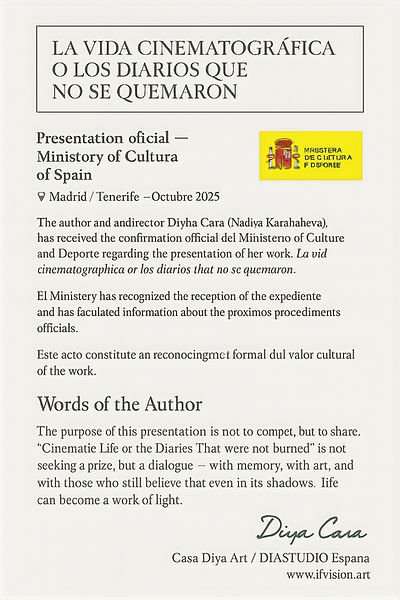
A curated archive documenting the official recognitions, cultural dialogues and artistic correspondences surrounding the works of Diya Cara — presented by IF Vision.
The archive's first entries confirm the growing recognition of the author's work across Europe. The epic memoir, "La vida cinematográfica o los diarios que no se quemaron" (Post-Cinematic Literature), has received official presentation confirmation from the Ministerio de Cultura y Deporte de España in Madrid. This formal act of cultural value recognition follows the work's earlier registration with the Gobierno de Canarias and its Cultural Recognition. The book, which contains the author's personal history, including life in the bombarded city of Jersón (Kherson), Kiev, and the "closed nuclear city," is a vital document of memory in the face of conflict and Madame J's influence. The author, Diya Cara, states that the work is not meant to compete, but to create a dialogue with memory, art, and the history that refuses to be burned.
The international scope of Diya Cara’s work is further validated by official French and global organizations. The book, "L’atelier des rêves - édition artistique", has received an official acknowledgment concerning the Dépôt légal (legal deposit) from the Bibliothèque nationale de France (BnF). This deposit symbolizes the continuity between memory, art, and light, and is recognized as a gesture of preservation, not formality. Concurrently, the author’s candidacy for the prestigious Prix des Cinq Continents de la Francophonie (OIF) has been officially confirmed. This literary award celebrates linguistic and creative diversity across 88 countries, solidifying Post-Cinematic Literature's position as a truly global cultural movement.

-
BnF — Bibliothèque nationale de France, Dépôt légal 2025
These official recognitions from cultural institutions — from the Gobierno de Canarias to La Francophonie — affirm the continuity and cultural value of Diya Cara’s 2011 creation, Post-Cinematic Literature.
Rooted in its ethical core, the movement stands as a poetic act of resistance — a dialogue between art, memory, and the human spirit in the age of war and generative AI.
As the author herself writes: “Each work is a bridge — between countries, between souls, between moments that refuse to disappear.”